
General, Whole Blood
400+ EMS Blood Programs Mark a Major Milestone, New Opportunity to Build Awareness
Jul
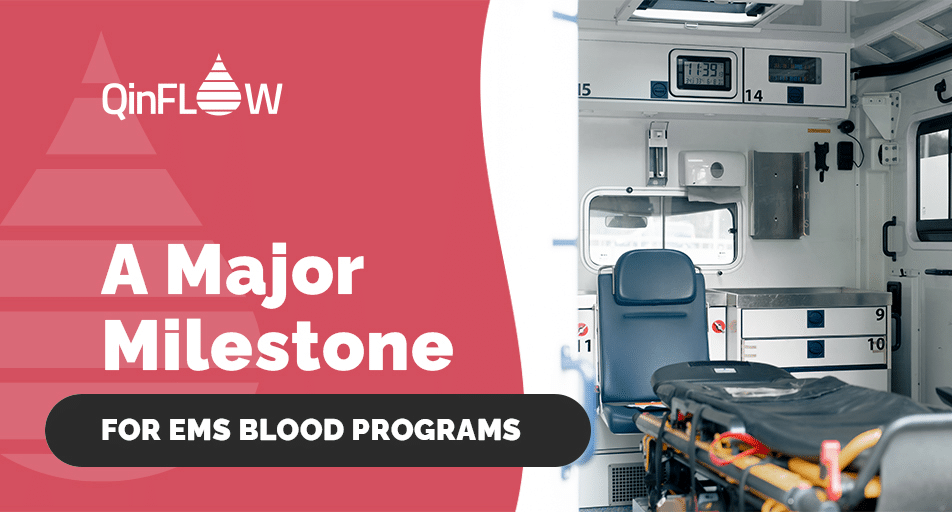
The prehospital care community has reached an important milestone: more than 400 ground EMS agencies across the United States now carry blood products to the scene of life-threatening emergencies.1
For perspective, only approximately five ground EMS agencies were known to carry blood in 2016. Reaching more than 400 programs reflects years of collaboration among EMS agencies, hospitals, blood centers, medical directors, researchers, policymakers, industry partners, and organizations such as the Prehospital Blood Transfusion Coalition. It also demonstrates that prehospital transfusion can be safely and successfully integrated into civilian EMS systems.
But the milestone may also raise an important question for members of the public: Don’t all ambulances carry blood?
In most communities, the answer is no.
Closing the Awareness Gap
Most people assume an ambulance can provide every intervention they associate with advanced emergency care. In reality, ambulance capabilities vary by system, staffing, state scope of practice, local resources, and access to regional healthcare partners.

That misconception matters. Communities cannot advocate for prehospital blood access if residents and local leaders assume the capability already exists. Residents and local leaders should be asking:
- Does our community currently have access to prehospital blood?
- Which agency provides it?
- Is coverage available throughout the region?
- Are local hospitals and blood suppliers involved?
- What would be required to expand access?
- And most importantly: Does access to prehospital blood really make that much of a difference to a patient?
The answer to the last question is yes.
Earlier Intervention Can Improve the Course of Care
For patients experiencing severe blood loss, access to blood before reaching the hospital can meaningfully change the course of care.
For a patient experiencing hemorrhagic shock, the time between the scene and hospital arrival can be critical. Prehospital blood programs allow appropriately trained EMS clinicians to begin replacing lost blood at the scene or during transport, giving the patient access to resuscitation sooner rather than waiting until arrival at the hospital. And the effects of that early intervention last beyond an ambulance ride.

The potential national impact is substantial. State mortality reports developed by the UT San Antonio Student, Resident and Fellows Trauma Advocacy Group in cooperation with PHBTC show that, in Texas alone, 13,198 people died in motor vehicle crashes between 2021 and 2023. Of those, 4,707, or 35.66%, were classified as presumed alive at the scene, meaning these patients may have benefited from lifesaving intervention before hospital arrival.4
The need also extends beyond motor vehicle crashes and other traumatic injuries. Hemorrhagic shock can result from gastrointestinal bleeding, ruptured aneurysms, obstetric emergencies, postsurgical complications, dialysis access complications, and other medical conditions.
Connected Communities Create Better Blood Access
Building on the momentum behind more than 400 ground EMS blood programs means thinking beyond individual agencies. The next phase of progress will depend on creating regional systems that make prehospital blood available across entire communities.
Not every EMS agency has the call volume, staffing, funding, or infrastructure to operate its own program. A regional approach allows agencies with the necessary infrastructure to support neighboring departments through mutual aid, coordinated response, and shared resources. But regional access is about more than deciding which units carry blood.
The strongest blood programs connect the entire continuum of care including…
- Ground EMS
- Air medical teams
- Hospitals
- Trauma centers
- Blood suppliers
- Medical directors
- Policymakers
- Community Leaders
When those teams partner as a connected system, blood can be available when needed, properly managed throughout the continuum of care, and supported by clear communication at every handoff. Patients can arrive at the hospital with resuscitation already underway, giving clinical teams a stronger starting point for continued treatment and creating greater potential for better outcomes.
Build on the Momentum – Take the Next Step with PHBTC

More than 400 ground EMS blood programs prove that progress is possible. But 400 is not the finish line – and the Prehospital Blood Transfusion Coalition is here to help.
The PHBTC brings together leaders from EMS, emergency medicine, trauma surgery, obstetrics, blood banking, research, government, and industry. Its clinical guidelines, state mortality data, advocacy resources, program map, and connections to established programs can help evaluate local access and begin planning regional solutions.
Once you have a clearer picture of your region’s current access, potential partners, and remaining barriers, PHBTC can help your team determine the next steps. The Coalition’s resources, expertise, and connections to established programs can support regional partners as they move from initial conversations toward implementation.
Now is the time to join teams across the nation redefining early intervention. Contact PHBTC to bring your regional partners together and begin building access to prehospital blood.
Sources
- Prehospital Blood Transfusion Coalition, “WASHINGTON, DC. Over 400 Ground EMS Agency Blood Transfusion Programs,” accessed July 15, 2026. https://prehospitaltransfusion.org/news/washington-dc-over-400-ground-ems-agency-blood-transfusion-programs/
- Bill Carey, “400+ EMS Agencies Now Carry Blood for 911 Calls,” EMS1, June 25, 2026. https://www.ems1.com/whole-blood/400-ems-agencies-now-carry-blood-for-911-calls
- Andrew-Paul Deeb et al., “Time to Early Resuscitative Intervention Association with Mortality in Trauma Patients at Risk for Hemorrhage,” Journal of Trauma and Acute Care Surgery 94, no. 4 (2023): 504–12. https://pmc.ncbi.nlm.nih.gov/articles/PMC10038862/
- Prehospital Blood Transfusion Coalition, “Texas State Sheets: FARS 2021–2023 Data,” PDF, accessed July 15, 2026. https://prehospitaltransfusion.org/state-mortality-reports/

