
Blood Warming
Compare the Path: What to Know Before Choosing a Blood and Fluid Warmer Disposable
Jul
Most blood and fluid warmer comparisons focus on the physical unit: size, weight, battery life, portability, and setup. For busy teams, those details do matter. But for the patient, what happens inside the disposable warming path matters even more.
The disposable unit is where cold blood becomes warm blood, where flow is either preserved or disrupted, and where engineering decisions directly shape clinical usability.
That makes the CDU, or Compact Disposable Unit, one of the most important parts of the warming system to evaluate. Before choosing a blood and fluid warmer disposable, teams should ask a few critical questions:
- Is the warming process safe and controlled?
- How does the fluid path affect blood quality?
- Can the system respond to pressure, bolus delivery, and changing flow rates?
- Does the per-use cost support practical adoption?
QinFlow’s CDU was engineered around these questions.
Is the Warming Process Safe and Controlled?
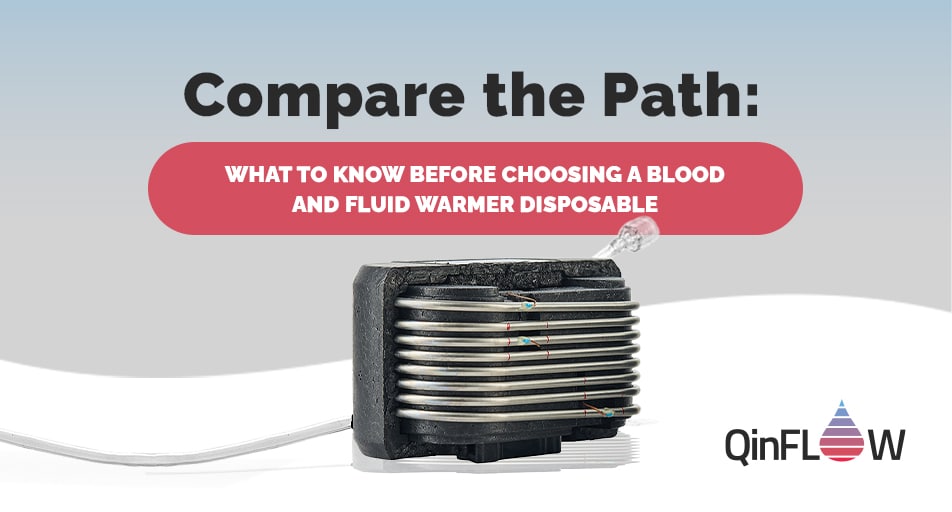
QinFlow’s Compact Disposable Unit, or CDU, is compact, but it was not designed around size alone. It was engineered around what happens to blood on the way to the patient prioritizing controlled warming, smooth flow, and rapid resuscitation performance.
Inside the CDU, QinFlow uses a controlled warming path designed to help maintain stable output temperature and responsive performance. That architecture includes:
- A 220 cm, or 7.2 ft, medical-grade stainless-steel coil, that is connected to a PVC tubing with standard luer-lock connections
- Temperature sensors positioned along the fluid path
- Communication with the Warrior Base Unit hundreds of times per second
- A target output temperature of 38°C, within ±2°C
However, blood and fluid warming is not simply about adding heat. It’s about applying heat in a way that is measured, stable, and responsive to changing flow conditions. QinFlow’s CDU is designed to prevent overheating by using continuous temperature sensing, incremental heat transfer, and no heating inertia, helping protect the patient from unintended thermal injury.
The result is a controlled warming pathway built for both performance and patient safety.
How Does the Fluid Path Affect Blood Quality?
Temperature control is only part of the equation. Warming performance also depends on how blood moves through the disposable.
A more compact disposable is not automatically a better warming path. If a warming architecture is overly compressed, the system may need to apply heat more aggressively or move blood through more restrictive pathways. That can increase the risk of localized overheating, turbulence, cavitation, or air bubble formation.
For blood products, those risks are not theoretical details. Platelets, coagulation factors, and other sensitive components can be affected by unnecessary mechanical or thermal stress.
QinFlow’s CDU is designed around a smooth, same-diameter fluid path that allows blood and fluids to move through a controlled line-extension pathway rather than a compressed or restrictive warming area. This design supports smooth flow while creating the surface area needed for gradual, consistent warming.
The CDU is designed to reach target temperature while supporting the way blood gets there.
Can the System Respond to Real Resuscitation Conditions?
Controlled flow matters in any setting, but it becomes especially important during urgent resuscitation.
The sickest patients rarely receive blood or fluids in perfectly steady, predictable conditions. Clinicians may need to use pressure bags, hand pumps, push-pull methods, syringe-driven bolus delivery, or rapid intermittent flows. In those moments, the warming system has to respond to what is actually happening at the bedside, in the ambulance, in the aircraft, or in the field.
QinFlow’s CDU was built for those realities, with support for:
- Blood product warming from very low flows and up to 180 ml per minute
- Room-temperature fluids at higher flow rates, depending on system configuration
- Pressure-assisted delivery
- Immediate response to flow changes during bolus delivery
Together, these capabilities allow the CDU to support rapid delivery conditions without compromising control.
Does the Per-Use Cost Support Practical Adoption?
Innovation only changes care when it is accessible enough to use. In blood and fluid warming, the cost of the disposable can influence whether warmed delivery becomes a practical part of routine protocols or something reserved for limited situations.
That matters because patients who could benefit from warmed blood or fluids may go without if the per-use cost is prohibitively expensive.
QinFlow helps make warmed delivery more practical with the lowest per-use price compared with modern portable blood and fluid warmers. That value extends across the Warrior platform. Because the CDU is compatible with Warrior and Warrior lite models, the same disposable can support patient movement across different care settings.
For clinicians, this means simplified handoffs and reduced unnecessary consumable use.. For procurement teams and program leaders, it means the disposable cost can better support broader adoption without adding unnecessary consumable complexity.
In Conclusion: Compare the Path, Not Just the Product
When comparing blood and fluid warmer disposables, the visible details are only part of the evaluation. Size, weight, and setup may help determine whether a warmer fits the workflow, but the stronger comparison starts inside the warming pathway.
QinFlow’s CDU was built around these questions. Its controlled warming architecture, smooth fluid path, responsive sensing, pressure-ready performance, and practical disposable cost all reflect a clear engineering philosophy: blood and fluid warming should be controlled, reliable, and usable in the moments clinicians need it most.
Compare your current blood and fluid warmer disposable with QinFlow’s CDU and see why the path matters.

